Ren Power Group
A solar marketplace connecting Nigerian homeowners, suppliers, and recyclers for trusted products, quotes, payments, and end-of-life services.
- Category
- SaaS Platform
- Timeline
- Q3 2024 - Present
- Stack
- Next.jsTypeScriptExpress.jsPostgreSQLPrisma+4 more
Overview — read the full write-up
Ren Power Group is a multi-sided solar marketplace built for the Nigerian energy ecosystem. It brings homeowners, manufacturers, distributors, and recyclers into one platform for discovering products, requesting quotes, managing listings, and accessing recycling services.
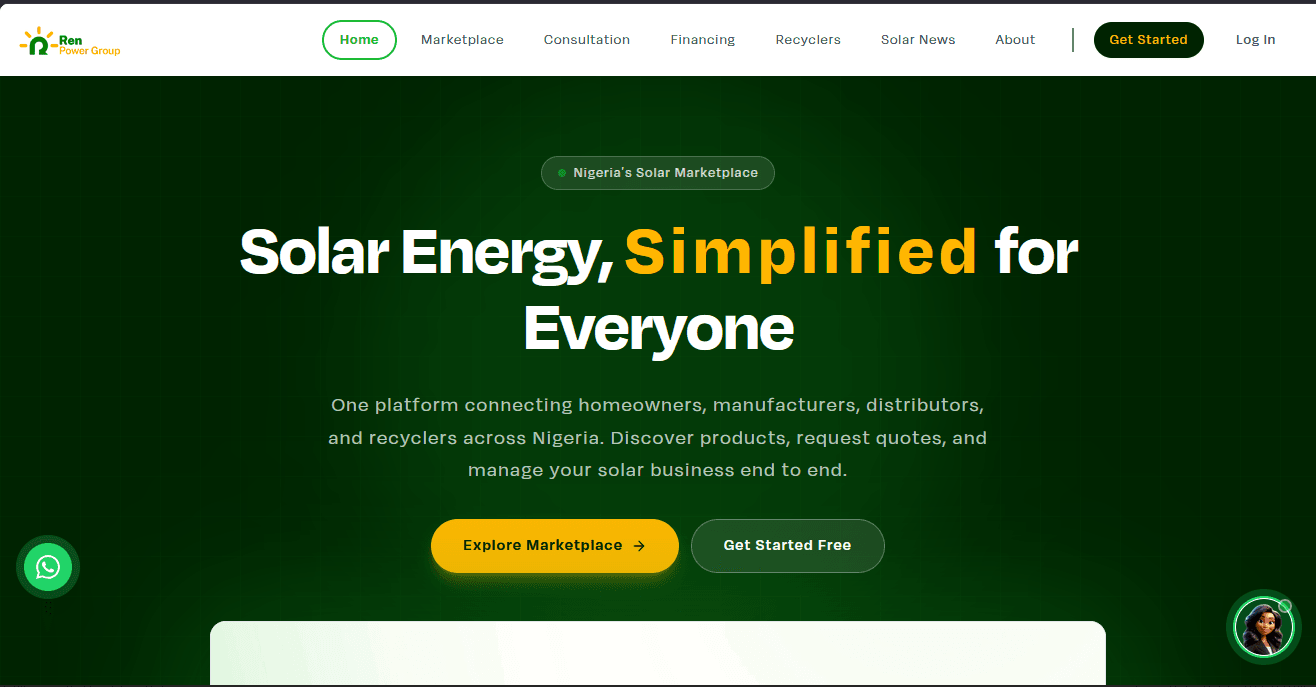
The product in action
Screenshot 1 of 4

The story in three parts
01 — The Challenge
Making Solar Shopping More Trustworthy
Read moreShow less
02 — The Strategy
One Platform for the Solar Ecosystem
Read moreShow less
03 — The Impact
A Marketplace Built Around the Full Solar Lifecycle
Read moreShow less
System Architecture
Separate Experiences, One Backend
Ctrl + scroll to zoom
Public Marketplace
The customer-facing application handles product discovery, provider browsing, quote requests, user dashboards, and marketplace interactions while keeping the experience focused on buyers and suppliers.
Provider Verification
The platform uses role-based access and an approval workflow to ensure providers and their listings can be reviewed before appearing publicly. This creates an additional layer of trust within the marketplace.
Centralized Backend
The Express API owns authentication, authorization, database operations, marketplace logic, and third-party integrations. Keeping these responsibilities centralized allows the public and admin applications to share the same business rules.
Configurable Business Rules
Important platform settings such as commission rates are stored in the database rather than hardcoded. This allows business rules to change without requiring a new application deployment.
Lessons & trade-offs
Separate Admin from the Marketplace
Keeping the admin experience in its own application introduced some additional deployment and configuration work, but made the separation between public and administrative functionality much clearer. For a marketplace with several distinct user roles, the isolation was worth the extra setup.
Clearer separation
Keep Business Rules Configurable
Moving the platform commission from application code into a database setting meant changes could be made without waiting for a deployment. It reinforced an important lesson: rules that business stakeholders may need to change should not always be hardcoded.
Without a deployment
Start Simple, Measure What Fails
The initial chatbot used keyword-based intent detection instead of introducing an external AI dependency. While less flexible, it was faster and cheaper to ship. Capturing user feedback created a path for identifying where a more capable approach would actually provide value.
Start simple
Want something like this built?
Ren Power Group is one example of how I work — from architecture to shipped product. If you have a problem that needs this kind of thinking, let’s talk.